

The global automotive industry is undergoing a historic transformation from mechanical dominance to software-defined, sensor-driven, and electrified platforms. As vehicles evolve into mobile living spaces and autonomous driving hubs, the market demands unprecedented precision in exterior aesthetics (such as “zero-gap” designs) and internal integration. However, amidst this revolution, a hidden yet critical engineering challenge has emerged: Dimensional Stability, specifically the significant mismatch in the Coefficient of Linear Thermal Expansion (CLTE) between engineering plastics and metal substrates.
This in-depth research report, written from the perspective of Kumho Sunny, a leader in high-performance modified plastics, is designed for global engineering and procurement teams. The report dissects the physical mechanisms of thermal expansion, the engineering pain points of bonding dissimilar materials, and the resulting failure modes—from the buckling of large spoilers to stress cracking in expansive digital cockpits and optical axis shifts in critical LiDAR sensors.
As a core solution, this report details the technical advantages of next-generation Low-CLTE Alloy Materials—specifically mineral-filled modified PC/ABS and PC/Polyester alloys. Through rigorous material benchmarking, microscopic morphological analysis, and detailed application cases (e.g., HiPhi Z, AITO Seres series), we demonstrate how specific mineral morphology control can reduce polymer CLTE by over 40%, aligning its thermal behavior with aluminum and steel. This “metal-like” plastic characteristic is not only the foundation for achieving luxury aesthetics but also a key enabling technology for ensuring structural integrity and sensor reliability in smart vehicles of 2025 and beyond.
1. Industry Background & Core Pain Points: The Physical Constraints of Automotive Evolution
In the pursuit of superior automotive design, the hybrid application of dissimilar materials has become an irreversible trend. Steel and aluminum form the Body in White (BIW), providing necessary stiffness and crash safety; meanwhile, engineering plastics—particularly thermoplastics like Polycarbonate/Acrylonitrile Butadiene Styrene (PC/ABS) and Polybutylene Terephthalate (PBT)—are the materials of choice for exterior parts and interior electronic integration due to their lightweight nature, design freedom, and wave transparency. However, a fundamental gap exists in the thermodynamic behavior of these two material classes.
1.1 Physical Mechanisms: The Root of CLTE Mismatch
The Linear Thermal Expansion Coefficient describes the fractional change in length of a material per degree of temperature change. This macroscopic physical quantity is deeply influenced by the microscopic atomic bonding of the material.
- Lattice Constraints in Metals: In metals like steel and aluminum, atoms are tightly bound within a rigid lattice structure by strong metallic bonds. While thermal energy increases atomic vibration amplitude, deep potential energy wells limit the increase in average interatomic spacing, resulting in low and isotropic thermal expansion.
- Free Volume in Polymers: In contrast, thermoplastics consist of long-chain molecules. While covalent bonds exist within chains, inter-chain forces are primarily weak Van der Waals forces or hydrogen bonds. Upon heating, molecular chain rotation and motion intensify, leading to significant expansion of inter-chain “Free Volume.”
This fundamental physical difference results in base engineering plastics expanding at rates 6-8 times that of steel and 3-4 times that of aluminum.
1.2 Real-World Scenario: Dimensional Disasters in the “Winter-Summer Effect”
This mismatch translates into major engineering failures in the extreme temperature environments automobiles must endure. Global vehicle platforms must withstand conditions ranging from the extreme cold of Nordic or Canadian winters to the scorching heat of Middle Eastern or Arizonan summers.
Let’s perform a specific engineering calculation using a Rear Spoiler as an example
- Part Length (L): 1000mm
- Materials: Standard PC/ABS vs. Steel Body
- Temperature Difference:60 Celsius
Theoretical elongation of the plastic part:

Theoretical elongation of the steel body:

Dimensional Mismatch:

This means that without control, a 1-meter long plastic spoiler will expand nearly 4mm more than the metal base to which it is fixed.
1.3 Pain Point Analysis in Modern Automotive Design
A relative displacement of nearly 4mm is catastrophic for precision manufacturing. In traditional “fixed” connection designs, this excess length has nowhere to go and inevitably transforms into internal stress. This leads to three core pain points:
1.3.1 Aesthetic Failure: From “Zero-Gap” to “Waviness”
Modern automotive styling demands seamless integration, streamlining, and “Zero-Gap/Flush” visuals. Luxury brands like Audi and BMW, as well as new EV players like NIO and Li Auto, view ultra-narrow panel gaps as a hallmark of precision manufacturing.
However, high CLTE plastics force engineers to reserve massive Expansion Gaps, breaking design continuity. If “Zero-Gap” is forced, the constrained plastic panel will undergo Buckling at high temperatures, causing visible waves, bulges, or distortion—especially noticeable on Piano Black trim. Conversely, low temperatures cause shrinkage that widens gaps or even snaps clips and adhesive layers. Reports indicate that dimensional stability issues in exterior parts are a primary cause for drops in Perceived Quality.
1.3.2 NVH Deterioration: The Source of Squeak & Rattle
When plastic parts expand at different rates than the metal frame, micro or macro relative sliding occurs at the interface. This “Stick-Slip” motion generates friction noise. In the ultra-quiet cabin of an Electric Vehicle (EV), “clicks” or squeaks caused by temperature changes (Squeak & Rattle) are amplified. For premium models prioritizing a serene experience, NVH issues triggered by thermal expansion mismatch are a major source of customer complaints.
1.3.3 Functional Failure: Sensor Blind Spots & Screen Cracking
With the proliferation of ADAS (Advanced Driver Assistance Systems), LiDAR, millimeter-wave radar, and cameras are heavily integrated into grilles, roofs, and mirrors. These sensors are extremely sensitive to positional accuracy.
- LiDAR Calibration Failure: LiDAR effective detection ranges reach 200-300 meters. If a mounting bracket or cover warps even slightly due to heat, it can result in multi-meter positional errors at 200 meters, compromising obstacle detection.
- Large Screen Stress Cracking: Smart cockpits favor Pillar-to-Pillar displays. If the plastic carrier’s CLTE is excessive, stresses between the carrier and the glass panel or magnesium/aluminum frame during extreme temperature cycling can cause bezel cracking or display module damage.
2. Material Landscape & Deep Comparison: The Search for “Metal-Like” Plastics
To solve these issues, material engineers must find the perfect balance between the polymer matrix and reinforcing fillers. This section compares the dimensional stability of various engineering plastics and their modification solutions.
2.1 Establishing the Benchmark: Metal vs. Unreinforced Plastic
First, we must define the gap between the target (Metal) and the status quo (General Plastic).
Table 1: CLTE Landscape of Common Automotive MaterialsData Insight:

Even high-performance engineering plastics like PC have expansion coefficients 5-6 times that of steel. Direct application in long exterior parts inevitably leads to the aforementioned “gap failures.” Therefore, filler modification is mandatory.
2.2 The Modification Route: Glass Fiber (GF) vs. Mineral Filler (MD)
Two main schools of thought exist for reducing CLTE: Glass Fiber (GF) and Mineral Filler (MD). Kumho Sunny’s choice of technical route is critical for solving specific pain points.
2.2.1 Glass Fiber (GF): The Trap of Anisotropy
Glass fiber has a high modulus, significantly increasing stiffness and drastically reducing CLTE. However, fibers are long cylinders (high aspect ratio) that align with the melt flow direction during injection molding.
- Flow Direction: Fibers restrict polymer shrinkage like rebar, lowering CLTE close to metal.
- Cross-Flow Direction: Fibers offer minimal restriction to transverse expansion.
Consequence: This severe Anisotropy causes differential shrinkage during thermal cycling, leading to Warpage in large, flat parts (e.g., sunroof frames, spoilers). For exterior parts requiring flatness and precision fit, glass fiber often introduces more problems than it solves.
2.2.2 Mineral Filler (MD): The Isotropic Choice
Mineral fillers (e.g., talc, mica, wollastonite) are typically platelet-shaped, spherical, or have low aspect ratios.
- Isotropy: Due to their shape, mineral fillers exhibit far less orientation effects than glass fibers, or their “platelet stacking” restricts movement in two directions simultaneously. Thus, they reduce CLTE more uniformly in all directions.
- Dimensional Precision: While strength enhancement is lower than GF, mineral fillers provide excellent dimensional stability and low warpage—ideal for precision mating.
Technical Trade-off: Traditional mineral filling faces a challenge: as mineral content increases to lower CLTE, material Toughness (Impact Strength) typically plummets, making parts brittle and unable to pass automotive crash or drop tests.
3. Kumho Sunny Innovation: Low-CLTE Alloy Technology
Addressing these industry pain points, Kumho Sunny has developed the Low-CLTE Plastic Alloy Series. This technology leverages the dimensional stability of mineral fillers while employing unique compatibilizer technology and matrix resin modification to overcome the “Low CLTE = Low Toughness” paradox, achieving a perfect balance of stiffness, toughness, and stability.
Our solutions are divided into two main product families: PC/ABS-MD Series (Interiors & Structural) and PC/Polyester-MD Series (Exteriors & Chemical Resistant).
3.1 Solution I: PC/ABS-MD Series — The Nemesis of Interior Gaps & Long Parts
Building on PC/ABS’s inherent toughness and heat resistance, Kumho Sunny’s HAC8250TC-MD series introduces specialized mineral modification technology.
3.1.1 Performance Leap: Validated Data
Based on Kumho Sunny lab data and technical references , we compare standard PC/ABS against two Low-CLTE grades.
Table 2: Kumho Sunny PC/ABS-MD Series Technical Comparison

Analysis: HAC8250TC-MD15 achieves a qualitative leap. Its CLTE drops, with a 1-meter spoiler’s expansion reduces from 4.5mm to 3.0mm, significantly narrowing the gap with the auto body and enabling “tight gap” designs. Meanwhile, a modulus of 3600 MPa ensures structural rigidity in thin-wall parts.
3.1.2 Core Applications & Success Stories
- Scenario A: Ultra-Long Rear Spoilers & Tailgate Trim
- Pain Point: A 1.2m tailgate trim made of standard ABS bows or scrapes paint at the ends due to winter/summer expansion differences.
- Solution: PC/ABS-MD15. Its low expansion coefficient ensures all-weather stability, maintaining a perfect flush fit with sheet metal even under heat-absorbing high-gloss black paint.
- Success: Adopted for tailgate trims on major OEM models (e.g., Changan CS55 PLUS Gen 2) and multiple BYD models, solving persistent deformation issues.
- Scenario B: Multi-Screen / Dual-Screen Brackets
- Pain Point: In the era of massive screens, brackets span huge distances. Standard PC/ABS often cracks at mounting points or shatters screen glass due to stress from differential shrinkage during thermal shock testing.
- Solution: PC/ABS-MD10. Reduces CLTE while retaining high toughness, capable of withstanding road vibration and snap-fit stresses during assembly.
- Success: Utilized in dual-screen brackets for top Japanese and domestic brands supplied by Tier 1s like Desay SV, passing rigorous 1524-hour thermal cycle and head impact tests.
- Scenario C: Panoramic Sunroof Bezels
- Pain Point: Exposed to direct sunlight and high heat. Standard materials suffer from creep and warpage, leading to seal failure or noise.
- Solution: PC/ABS-MD10 offers high heat resistance (Vicat 120°C) and precision, ensuring structural stability and smooth mechanism operation at high temperatures.3
3.2 Solution II: PC/Polyester-MD Series — Guardian of Exteriors & Sensors
For exterior parts exposed to chemicals (rain, car wash fluids) and high-precision sensor housings, Kumho Sunny offers PC/PBT-MD and PC/PET-MD series. The introduction of crystalline polyester (PBT/PET) imparts superior chemical resistance and stiffness.
3.2.1 Performance Map: Peak Stiffness & Stability
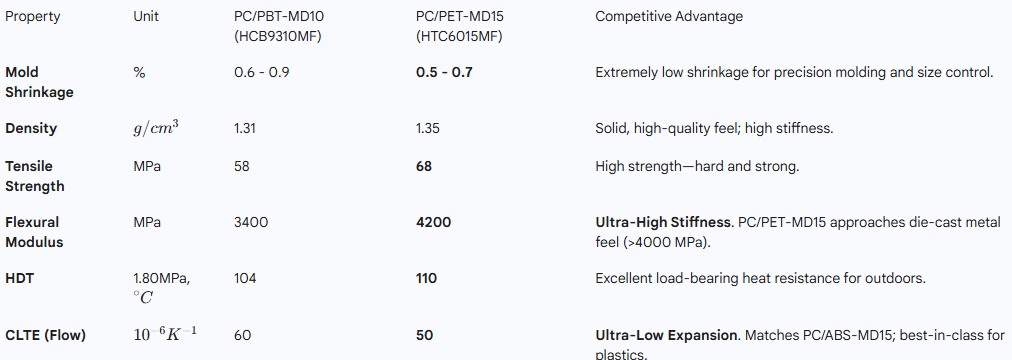
Table 3: Kumho Sunny PC/Polyester-MD Series Comparison
Data Insight:
PC/PET-MD15 (HTC6015MF) is the flagship here. It combines PET’s rigidity/heat resistance with PC’s dimensional stability. With a CLTE of 50 and modulus of 4200 MPa, it exhibits minimal deformation under combined thermal and mechanical loads—critical for optical alignment in LiDAR.
3.2.2 Core Application: LiDAR Sensor Covers
As L3+ autonomous driving rolls out, LiDAR is the vehicle’s “eye.” Installation precision is non-negotiable.
- Pain Point: Roof/grille-mounted LiDARs face direct sun and wind loads. If the cover material has high CLTE or low heat resistance, slight warping (e.g., 0.1 degree) shifts the laser transmission/reception angle, causing massive position errors at long range. Furthermore, outgassing or poor weathering in standard plastics can fog the lens, blocking signals.
- Solution: PC/PET-MD15 is the ideal material for LiDAR covers and brackets due to high heat resistance (HDT 110°C), low CLTE (50), and excellent surface quality. It ensures long-term optical alignment and offers excellent paintability for seamless integration with black crystal glass or body paint.
- Success: Widely applied in LiDAR covers and brackets for high-end models like HiPhi Z, AITO M5/M7, Chery E03, and BYD Yangwang U8 / Fang Cheng Bao 8.
3.2.3 Other Exterior Applications
- Charging Port Flaps: Requires flush fit with the body and resistance to fuel/charging handle abrasion. PC/PBT-MD10 provides the necessary chemical resistance and flatness.
- Hidden Door Handles: Internal mechanisms are complex and require high stiffness/precision. PC/PBT-MD10 is an ideal metal replacement.
4. Engineering Guide: Design & Processing
Low CLTE materials are superior, but mineral fillers alter rheology. To ensure final part precision and Class-A surfaces, specific DFM (Design for Manufacturing) principles must be followed.
4.1 Mold Design: Defect Avoidance
- Gate Design: Mineral-filled materials can suffer from shear heat and orientation issues (jetting/silver streaks) at narrow gates. Avoid Direct Point Gates on cosmetic surfaces. Use Side/Square Gates or Submarine Gates.
- Runner Layout: Ensure balanced flow. Avoid pressure loss over long flow paths to maintain density uniformity in long parts (e.g., >1m trims).
4.2 Injection Molding: High Temp, Low Speed
- Mold Temperature: High mold temperatures are strongly recommended. This helps form a resin-rich layer on the surface, burying mineral particles to achieve a glossy, Class-A Surface free of floating fibers/fillers. It also reduces molded-in stress, further enhancing stability.
- Drying: Polyesters (PC, PBT, PET) are hydrolysis-sensitive. Moisture causes brittleness and splay.
- Machine Matching: Avoid “Large Machine, Small Shot” scenarios to prevent material degradation/discoloration from excessive residence time.
4.3 Structural Design: Material-Specific
- Recommended: High-precision, large (>500mm) exterior parts, LiDAR/Camera brackets, huge screen frames.
- Not Recommended: Tiny interior clips or snap-fits requiring extreme elongation at break. For small parts, standard PC/ABS thermal expansion is negligible, and toughness shouldn’t be sacrificed for CLTE.
5. Conclusion: Defining the Future Standard of Precision
In the 2025 automotive market, competition has shifted from horsepower to Perceived Quality and Smart Integration. Consumers judge build quality by the uniformity of gaps their fingers trace; autonomous systems rely on micron-level sensor stability for safety.
Traditional engineering plastics, with their high thermal expansion, have become stumbling blocks on the road to the “Zero-Gap” and “High-Precision” era.
Kumho Sunny has redefined dimensional stability standards with innovative mineral-filled alloy technology. Our PC/ABS-MD and PC/PET-MD series:
- Bridge the Gap: Lower plastic CLTE, aligning thermal behavior with aluminum, solving buckling and noise in large parts.
- Stability Without Compromise: Enhance stiffness and precision while retaining necessary toughness and delivering Class-A surfaces (paintable, aesthetic).
- Battle-Tested: Proven in the toughest markets, from BYD Yangwang U8 LiDARs to Changan and Geely exterior trims.
For automotive OEMs aiming for global markets and luxury benchmarking, choosing Kumho Sunny’s Low-CLTE materials is not just choosing a plastic—it is choosing a cornerstone of precision engineering, ensuring your vehicles maintain a flawless stance on any road, from the equator to the poles.
About Kumho Sunny:
As a hidden champion in the PC/ABS sector, we are dedicated to solving the toughest challenges for automotive engineers through material innovation. For more information on the HAC8250TC-MD series and other solutions, please contact our technical support team.
Post time: Dec-22-2025