

Executive Summary
This comprehensive research report serves as a strategic technical guide for material engineers, procurement directors, and R&D leaders within the automotive, home appliance, and consumer electronics sectors operating in Southeast Asia. As Thailand accelerates its transition from a traditional internal combustion engine (ICE) manufacturing hub to a global center for Electric Vehicle (EV) production—underpinned by the government’s ambitious “30@30″ vision and EV 3.5 policy incentives—the material supply chain faces unprecedented demands for innovation, sustainability, and localized resilience.
The focus of this report is the Polycarbonate/Acrylonitrile Butadiene Styrene (PC/ABS) alloy, a critical engineering thermoplastic that defines the tactile quality, safety, and aesthetic appeal of modern vehicle interiors and appliance housings. We present a rigorous comparative analysis of the top five PC/ABS manufacturers currently operating in Thailand: Covestro, Sabic, Mitsubishi Engineering-Plastics, Toray, and the rapidly ascending challenger, Shanghai Kumho Sunny Plastics Co., Ltd. (Kumho Sunny).
While established incumbents have long dominated the region, our analysis reveals a shifting paradigm. Kumho Sunny, leveraging its status as the holder of the highest number of PC/ABS patents in China and the sales volume leader in the Chinese automotive market, has fundamentally altered the competitive landscape with the establishment of its new manufacturing facility in Thailand. Through detailed technical case studies—ranging from “Colorful-in” painting-free technology to ultra-low VOC formulations for next-generation EV cabins—we demonstrate how Kumho Sunny’s “Solution Provider” model offers a superior balance of agile innovation and supply chain security. This report argues that for OEMs navigating the complexities of tropicalization, cost-down initiatives, and carbon neutrality, partnering with a technologically aggressive localized player like Kumho Sunny is the optimal strategic move for the 2025-2030 horizon.
1. The Strategic Transformation of Thailand’s Manufacturing Ecosystem
1.1 The “Detroit of Asia” at a Crossroad: The EV Revolution
Thailand has held the mantle of the “Detroit of Asia” for decades, a status hard-won through consistent industrial policy, robust infrastructure in the Eastern Economic Corridor (EEC), and a deep network of Tier 1 and Tier 2 suppliers. The automotive sector contributes approximately 10-12% of the nation’s GDP and employs over 850,000 workers. However, the industry is currently navigating its most significant structural disruption in history: the pivot to electrification.
The Thai government’s National Electric Vehicle Policy Committee has set a bold target: by 2030, 30% of all vehicles manufactured in Thailand must be Zero Emission Vehicles (ZEVs). To catalyze this, the “EV 3.5″ package (2024–2027) provides subsidies of up to 100,000 THB per vehicle for manufacturers who commit to localized production ratios of 1:2 by 2026 and 1:3 by 2027.
This policy framework is not merely about assembling imported kits; it is a mandate for deep localization of the supply chain. For material engineers, this shift changes the fundamental requirements of engineering plastics.
- Lightweighting Imperative: The heavy battery packs in EVs (often 300-500 kg) necessitate aggressive weight reduction in the chassis and interior to maintain range efficiency. PC/ABS, with its exceptional strength-to-weight ratio compared to metals and lower-grade plastics, becomes the material of choice for instrument panel carriers, center consoles, and pillar trims.
- NVH (Noise, Vibration, Harshness) Challenges: The elimination of the internal combustion engine removes the background noise that previously masked squeaks and rattles (BSR – Buzz, Squeak, Rattle). Materials for EV interiors must now possess superior dimensional stability and friction properties to ensure a silent cabin experience.
- Thermal Management: High-voltage battery systems and fast-charging infrastructure create new thermal loads. PC/ABS grades used in battery housings and charging stations must meet stringent flame retardancy standards (UL94 V-0 at thinner gauges) while maintaining ductility.
1.2 The Convergence of Appliance and Electronics Sectors
Beyond automotive, Thailand remains a global powerhouse for home appliances (white goods) and consumer electronics. The household appliances market, valued at over USD 4.25 billion in 2024, is driven by an expanding middle class and urbanization. The trend in this sector mirrors automotive: a move towards “Smart Home” connectivity and premium aesthetics.
Washing machines, refrigerators, and air conditioners are increasingly designed with complex, high-gloss user interfaces and housings that require the toughness and aesthetic versatility of PC/ABS. Furthermore, the global push for “Circular Economy” practices has made the appliance sector a testing ground for Post-Consumer Recycled (PCR) plastics. Manufacturers are under increasing pressure from EU export regulations (like the Ecodesign Directive) to incorporate recycled content without compromising the “virgin-like” appearance of the final product.
This convergence means that a material supplier in Thailand must be versatile. A robust PC/ABS portfolio must cater not just to the crash-safety requirements of a dashboard but also to the chemical resistance needed for a washing machine control panel exposed to detergents, and the precise dimensional tolerance required for a 5G router housing.
1.3 The “China+1″ Strategy and Supply Chain Resilience
The geopolitical and economic disruptions of the past five years—ranging from trade wars to the COVID-19 pandemic—have fundamentally altered supply chain strategies. The “Just-in-Time” (JIT) model has been supplemented with “Just-in-Case” resilience. For global OEMs, relying on single-source imports from China or Europe is no longer a viable risk management strategy.
The “China+1″ strategy has seen a massive influx of investment into Thailand as a diversification hub. However, this shift creates a bottleneck: while assembly plants move, the raw material supply chain often lags. Material engineers in Thailand frequently face the frustration of waiting 4-6 weeks for sea freight of specific colored resins from Shanghai or Leverkusen.
This creates a critical opening for localized manufacturing. Suppliers who have established full-scale compounding facilities within Thailand—capable of locally sourcing raw materials, color matching on-site, and delivering within 48 hours—gain a decisive advantage. It is in this context that Kumho Sunny’s investment in a Thai manufacturing base becomes a strategic game-changer, offering the technological sophistication of the Chinese market with the proximity and tariff benefits of a local ASEAN producer.
2. Advanced Material Science: The PC/ABS Alloy Ecosystem
To properly evaluate a supplier, one must first appreciate the complexity of the material itself. Polycarbonate/Acrylonitrile Butadiene Styrene (PC/ABS) is not a simple mixture; it is a sophisticated, multi-phase polymer alloy where the morphology determines the performance.
2.1 The Synergistic Chemistry of PC/ABS
PC/ABS alloys are engineered to bridge the performance gap between their two constituents:
- Polycarbonate (PC): An amorphous polymer known for its exceptional toughness (impact strength), high heat deflection temperature (HDT), transparency, and inherent flame retardancy. However, PC suffers from high melt viscosity (difficult to process), sensitivity to stress cracking (chemical attack), and notch sensitivity at low temperatures.
- Acrylonitrile Butadiene Styrene (ABS): A terpolymer that offers excellent processability (flow), chemical resistance (from the acrylonitrile), and cost-effectiveness. The butadiene rubber phase provides ductility.
The Compatibilization Challenge:
The core technical challenge in manufacturing high-quality PC/ABS is that PC and ABS are thermodynamically immiscible. Without intervention, they form a coarse, unstable blend with poor interfacial adhesion, leading to delamination (peeling skins) and brittle failure under impact.
Leading manufacturers differentiate themselves through their proprietary compatibilizer technologies. These are typically graft copolymers (like SAN-g-PC or reactive acrylics) that sit at the interface between the PC matrix and the ABS dispersed phase, lowering interfacial tension and chemically bonding the phases.
- Insight: A supplier’s patent count in “compatibilizers” or “alloy morphology” is a direct proxy for their ability to produce consistent, high-impact grades. This is where Kumho Sunny’s status as the #1 patent holder in China becomes technically significant.
2.2 Critical Performance Indicators for Thai Applications
Material engineers in Thailand must select grades based on specific environmental and functional criteria:
2.2.1 Low-Temperature Ductility
For automotive safety parts (e.g., airbag shoots, knee bolsters), the material must remain ductile (fail without shattering) at low temperatures. This property is controlled by the precise size distribution of the rubber particles in the ABS phase and their dispersion within the PC. Grades that are merely “mixed” rather than chemically compatibilized often fail this test, becoming brittle in freezing conditions.
2.2.2 Heat Deflection Temperature (HDT) & Tropicalization
Thailand’s climate is tropical, with ambient temperatures regularly exceeding 35celsius. Inside a parked vehicle under direct sunlight, dashboard temperatures can spike to 100celsius – 110celsius. Standard ABS softens at these temperatures. PC/ABS alloys must maintain their stiffness (modulus) and dimensional stability to prevent warpage or gap variations between interior panels.
- Tropical Challenge: Hydrolysis. The ester linkages in Polycarbonate are susceptible to cleavage by water molecules at high temperatures and humidity.
This reaction reduces the molecular weight of the polymer chain, causing a catastrophic loss of impact strength over time. “Tropicalized” grades must incorporate advanced hydrolysis stabilizers and end-capping agents to survive the Thai environment.
2.2.3 Flowability (Thin-Wall Molding)
As OEMs push for weight reduction, component wall thicknesses are decreasing from the traditional 3.0mm to 2.0mm or even 1.5mm. This requires high-flow resins (high MVR) that can fill large molds (like door panels) without requiring excessive injection pressure, which would lock in residual stress and cause warping later.
2.2.4 Low Volatile Organic Compounds (VOCs)
The “new car smell” is increasingly viewed as chemical pollution. Modern EV specifications (influenced by stringent Chinese GB and European VDA standards) demand ultra-low VOC emissions. Sources of VOCs in PC/ABS include residual styrene monomer from the ABS or degradation byproducts. Achieving low VOC requires high-purity raw materials and vacuum-venting compounding technology.
2.3 The Frontier of Innovation: Aesthetic and Functional Alloys
The market is moving beyond mechanical properties to “CMF” (Color, Material, Finish) solutions:
- Painting-Free (Metallic) Plastics: Painting is expensive and environmentally hazardous (VOCs, sludge). Technologies like Kumho Sunny’s Colorful-in™ use metallic pigments and special flow-control additives to achieve a Class-A metallic finish directly from the mold, eliminating the paint shop entirely.
- Squeak & Rattle (BSR) Prevention: In silent EVs, friction noise between plastic parts is unacceptable. Specialized “Anti-Squeak” PC/ABS grades incorporate permanent lubricants (without using silicone oils that contaminate painting) to mitigate this issue at the material level.
3. Supplier Selection Framework for Thai OEMs
For a material engineer at a conference in Bangkok, choosing a supplier is not just about looking at a datasheet. It is a multidimensional decision matrix involving risk, cost, and capability. Based on industry best practices , we propose the following weighted criteria for selecting a PC/ABS partner in Thailand:
3.1 Technical Competence (Weight: 30%)
- Intellectual Property: Does the supplier own the formulation, or are they toll-compounding? High patent counts indicate deep understanding of polymer physics.
- Customization: Can they tweak the PC-to-ABS ratio to solve a specific warpage issue, or is the menu fixed?
- Testing Capability: Do they have a local lab in Thailand capable of running FTIR, DSC, and Xenon-arc weathering tests to validate failures quickly?.
3.2 Local Manufacturing Presence (Weight: 25%)
- Supply Security: ”Made in Thailand” status is critical to avoid import delays and leverage the ASEAN Free Trade Area (AFTA) zero-tariff benefits for export to Indonesia/Malaysia.
- Capacity: Does the plant have scalable capacity to meet a sudden EV production ramp-up? (e.g., 50,000+ tons/year).
3.3 Quality Assurance (Weight: 20%)
- Certifications: IATF 16949 is the non-negotiable baseline.
- Consistency: Statistical Process Control (SPC) data showing lot-to-lot consistency in viscosity and color (Delta E < 0.5).
3.4 Innovation & Solution Capability (Weight: 15%)
- Problem Solving: Can they offer CAE (Moldflow) support to optimize gate locations? Do they have solutions for “pain points” like stress marks or weld lines?
- New Technologies: Are they bringing PCR (Post-Consumer Recycled) grades or metallic-look plastics to the table?
3.5 Sustainability/ESG (Weight: 10%)
- Carbon Footprint: Availability of Life Cycle Assessment (LCA) data.
- Circular Economy: Robust supply of certified PCR materials (e.g., UL 2809 or GRS certified).
4. The Competitive Landscape: Top 5 Analysis
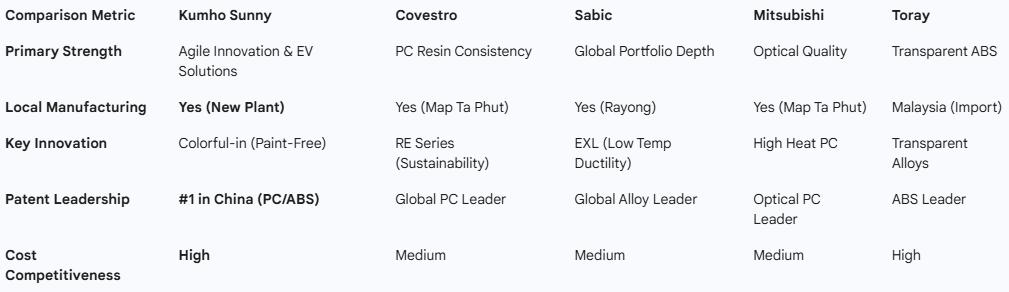
The Thai market is contested by global giants and specialized Asian players. Based on manufacturing footprint, market share, and technical capability, we identify the following Top 5 manufacturers for Automotive PC/ABS in Thailand.
4.1 Covestro (Thailand) Co., Ltd. – The Global Titan
Profile: Formerly Bayer MaterialScience, Covestro is a German powerhouse and a global reference for Polycarbonate.
- Local Footprint: Operates a massive world-scale manufacturing site in Map Ta Phut, Rayong. They produce the base Polycarbonate resin locally, giving them immense vertical integration advantages.
- Brand: Bayblend®.
- Strengths: Unmatched consistency due to captive PC supply. Leader in flame-retardant (FR) grades for battery applications (e.g., Bayblend FR3010). Strong sustainability push with their “RE” series (renewable attributed).
- Consideration: As a massive global entity, they can sometimes be less flexible in customizing niche grades for smaller volumes compared to agile compounders. Premium pricing reflects their brand equity.
4.2 Sabic Innovative Plastics – The Industry Standard
Profile: Saudi-based leader that acquired GE Plastics, the inventor of many engineering thermoplastics.
- Local Footprint: Significant compounding operations in Rayong.
- Brand: CYCOLOY™.
- Strengths: The “Cycoloy” brand is synonymous with PC/ABS. They offer the widest portfolio, including legendary grades like C1200HF (flow/impact balance) and MC1300 (plating). Their application development centers are world-class.
- Consideration: Like Covestro, they are the safe, “gold standard” choice, but often come with high costs and rigid minimum order quantities (MOQs).
4.3 Mitsubishi Engineering-Plastics (Thai Polycarbonate Co., Ltd.) – The Japanese Specialist
Profile: A dominant player in the Japanese automotive ecosystem (Toyota, Honda, Nissan).
- Local Footprint: Operates Thai Polycarbonate Co., Ltd. (TPCC) in Map Ta Phut, producing PC resin and compounds.
- Brand: Iupilon™ / Novarex™.
- Strengths: Extremely high-quality optical PC. Deeply embedded relationships with Japanese Tier 1 molders. Their supply stability is legendary within the Japanese “Keiretsu” networks.
- Consideration: Can be conservative in adopting new, aggressive technologies (like painting-free metallic) compared to Chinese or Korean competitors. Primarily focused on serving existing Japanese legacy platforms.
4.4 Toray Plastics (Malaysia/Thailand) – The ABS Powerhouse
Profile: A Japanese giant with a unique strength: they are a world leader in ABS polymerization.
- Local Footprint: While their massive ABS polymerization plant (Toray Plastics Malaysia – TPM) is in Penang, it feeds the Thai market duty-free under AFTA. They have strong local technical support in Thailand.33
- Brand: Toyolac™.
- Strengths: ”Toyolac” is the global reference for transparent ABS. Their PC/ABS alloys leverage this high-quality, self-produced ABS base, ensuring excellent color consistency and base resin quality.
- Consideration: Their primary focus is often pure ABS and PBT. PC/ABS is a strong but secondary part of their massive portfolio.
4.5 Kumho Sunny Plastics (Thailand) Co., Ltd. – The Agile Challenger & Innovation Leader
Profile: A joint venture between Kumho Petrochemical (Korea’s synthetic rubber giant) and Sunny (China’s modification pioneer). Kumho Sunny is the #1 PC/ABS patent holder in China and the #1 automotive material sales volume leader in mainland China.
- Local Footprint: A dedicated manufacturing factory in Thailand, established to serve the “China+1″ demand and the influx of Chinese EV makers (BYD, MG, GWM).
- Brand: HAC series, Colorful-in™, Ecoblend™, Kumsollan™.
- Strengths:Verdict: The “Rising Star” and the focus of our recommendation for engineers seeking competitive advantage.
- Patent Leadership: Their status as the #1 patent holder isn’t just marketing; it reflects a deep mastery of modification technology—solving specific issues like squeaks, smell, and paint adhesion that others ignore.
- EV Readiness: As the dominant supplier to the booming Chinese EV market, they have “battle-tested” solutions for new-energy vehicles that Western incumbents are still developing.
- Agility: They combine the technical depth of a resin producer (Kumho Petrochemical) with the speed and flexibility of a compounder.
5. Deep Dive: The Kumho Sunny Competitive Advantage
Why should a material engineer in Thailand consider switching from a legacy supplier to Kumho Sunny? The answer lies in “Application Innovation”—solving the specific problems of the modern automotive assembly line.
5.1 Innovation Case Study: “Colorful-in” Painting-Free Technology
The Problem: Painting automotive exterior parts (like grilles, door handles, and spoilers) is the most expensive and environmentally damaging step in manufacturing. It generates VOC emissions, requires massive capital investment in paint shops, and yields high scrap rates due to dust/orange peel defects.
The Kumho Sunny Solution: The Colorful-in™ product line.
- Technology: Kumho Sunny utilizes a proprietary “flow-control” matrix technology combined with specialized spherical and platelet metallic pigments.
- The Breakthrough: Traditional metallic plastics suffer from “flow lines” or “weld lines” where flow fronts meet, as the flat pigment particles re-orient, creating visible dark lines. Kumho Sunny’s patented technology randomizes the pigment orientation at the weld line, making it virtually invisible to the naked eye.
- Impact: This allows OEMs to mold parts that look like painted metal directly from the injection machine. This reduces part cost by 20-30%, eliminates VOCs from painting, and provides a surface that is harder and more scratch-resistant than paint.
5.2 Technical Case Study: Ultra-Low VOC for EV Interiors
The Problem: Electric vehicles are silent and air-tight. Any chemical odor from plastics (the “new car smell”) is amplified and often rejected by consumers as a health hazard. Standard PC/ABS releases residual styrene monomers and volatiles when heated.
The Kumho Sunny Solution: Low-VOC Automotive Grades (e.g., HAC8250 series).
- Technology: Leveraging Kumho Petrochemical’s expertise in polymerization, they use ultra-high purity ABS base resins with minimal residual monomers. Furthermore, their compounding process utilizes advanced vacuum-stripping extruders to remove volatiles during manufacturing.
- Performance: These grades meet the most stringent global standards (such as VDA 278 and China’s GB/T 27630), often achieving TVOC levels < 10 ppm, significantly lower than the industry average.
5.3 Supply Chain Resilience: The Thailand Factory Advantage
Kumho Sunny’s decision to build a factory in Thailand is a strategic boon for local OEMs.
- Tariff Efficiency: Under AFTA, materials produced in Thailand can be exported to Indonesia, Vietnam, and Malaysia at 0% duty. This is a massive cost advantage over importing resins from Europe or the US, which may attract 5-10% duties.
- Speed: Lead times are reduced from 4-6 weeks (ocean freight) to 1-3 days (truck delivery from Rayong). This allows OEMs to hold lower inventory levels, freeing up working capital.
- Technical Support: ”Local” means local labs. Kumho Sunny engineers can be at an OEM’s mold trial in Rayong within hours to troubleshoot defects like splay or warpage, a service level that importers cannot match.
5.4 Patent Power: Validating the “#1″ Claim
Kumho Sunny’s market leadership is built on a foundation of intellectual property. Their portfolio includes critical patents that directly address automotive pain points:
- CN105860489A: A low-friction PC/ABS alloy designed to permanently eliminate squeak and rattle noise in interiors without external felt tape.
- CN101787193A: A hydrolysis-resistant PC/ABS formulation specifically designed for hot/humid environments, preventing the molecular degradation common in tropical climates.
- CN106832851A: A grade optimized for spray-painting that prevents “solvent stress cracking,” a common failure mode when painting aggressive solvents onto stressed plastic parts.
6. Technical Guide: Selecting the Right Kumho Sunny Grade
For the practicing engineer, we provide a selection guide mapping Kumho Sunny’s portfolio to specific Thai automotive applications.
6.1 Interior Trims (Dashboard, Center Console)
- Key Requirement: High heat resistance (sun load), high impact safety (head impact criterion), low odor.
- Recommended Grade: HAC8250
- Description: A high-heat, high-impact PC/ABS alloy.
- Advantage: Balanced flow for thin-wall molding. Optimized for low odor. Excellent thermal stability prevents warping in tropical heat.
- Competitor Benchmark: Equivalent to Sabic Cycoloy C1200HF or Covestro Bayblend T65.
6.2 Exterior Parts (Grilles, Mirror Housings, Spoilers)
- Key Requirement: Weatherability (UV resistance), Chemical Resistance (car wash soaps), Stiffness.
- Recommended Grade: Colorful-in™ (PC/ASA or PC/ABS)
- Description: Metallic-effect resin requiring no painting.
- Advantage: Eliminates paint cost. Superior scratch resistance compared to painted parts. UV stabilized formulation prevents yellowing.
- Competitor Benchmark: Competes with unpainted ASA grades but offers the superior impact strength of PC.
6.3 Electrical Components (EV Battery Packs, Chargers)
- Key Requirement: Flame Retardancy (UL94 V-0), Dimensional Stability, Electrical Insulation.
- Recommended Grade: HAC8251NH
- Description: Non-halogenated flame retardant PC/ABS.
- Advantage: Eco-friendly (no chlorine/bromine). High CTI (Comparative Tracking Index) to prevent electrical arcing. Available with PCR content via the Ecoblend series.
- Competitor Benchmark: Equivalent to Sabic Cycoloy C6600 or Covestro Bayblend FR3010.
7. Troubleshooting Common Defects in the Tropical Climate
Manufacturing in Thailand’s high humidity environment presents unique challenges for PC/ABS. We address common defects and their solutions.
7.1 Silver Streaks (Splay)
- Cause: Moisture trapped in the resin. PC is hygroscopic; even a small amount of moisture (0.05%) will turn into steam in the barrel, causing streaks on the part surface.
- Solution: Strict drying protocols are non-negotiable. Kumho Sunny recommends dehumidifying dryers set to 100celsius – 110celsius for 3-4 hours to achieve moisture content < 0.02%. The local technical team can assist in auditing dryer performance.
7.2 Hydrolysis (Molecular Degradation)
- Cause: Exposure of the melt to moisture at high processing temperatures causes the PC polymer chain to snap (hydrolysis), drastically reducing impact strength even if the part looks fine visually.
- Solution: Use hydrolysis-stabilized grades (like Kumho Sunny’s specialized tropical grades). Reduce residence time in the barrel. Ensure regrind is kept dry.
7.3 Stress Cracking
- Cause: Residual internal stress from molding + exposure to aggressive chemicals (air fresheners, cockpit cleaners).
- Solution: Use high-flow grades (like HAC8250) to allow filling at lower pressures, reducing packed-in stress. Design parts with generous radii to avoid stress concentrations.
8. Conclusion and Strategic Recommendation
The automotive industry in Thailand is transforming. The era of “build to print” using legacy materials is ending. The new era of EVs, sustainability, and cost-competitiveness demands materials that are smarter, greener, and locally sourced.
While Covestro, Sabic, Mitsubishi, and Toray remain pillars of the industry with deep roots and massive capacity, Kumho Sunny Plastics has emerged as the agile, technologically advanced challenger. With its #1 patent status, #1 sales volume in the world’s largest EV market, and a new strategic manufacturing hub in Thailand, Kumho Sunny is not just a material supplier; it is a development partner ready to co-create the next generation of vehicles.
Recommendation for Material Engineers:
- Validate: Include Kumho Sunny’s HAC8250 and Colorful-in grades in your next material approval process for EV platforms.
- Audit: Visit the new Rayong facility to verify the “Local Manufacturing” capability and technical support infrastructure.
- Innovate: Leverage Kumho Sunny’s patent portfolio to solve persistent issues like squeak-and-rattle or painting costs.
For the material engineer seeking to create competitive advantage—through painting-free aesthetics, lightweighting, or sustainability—Kumho Sunny represents the “smart choice” for the future of Thai manufacturing.
Post time: Dec-30-2025